
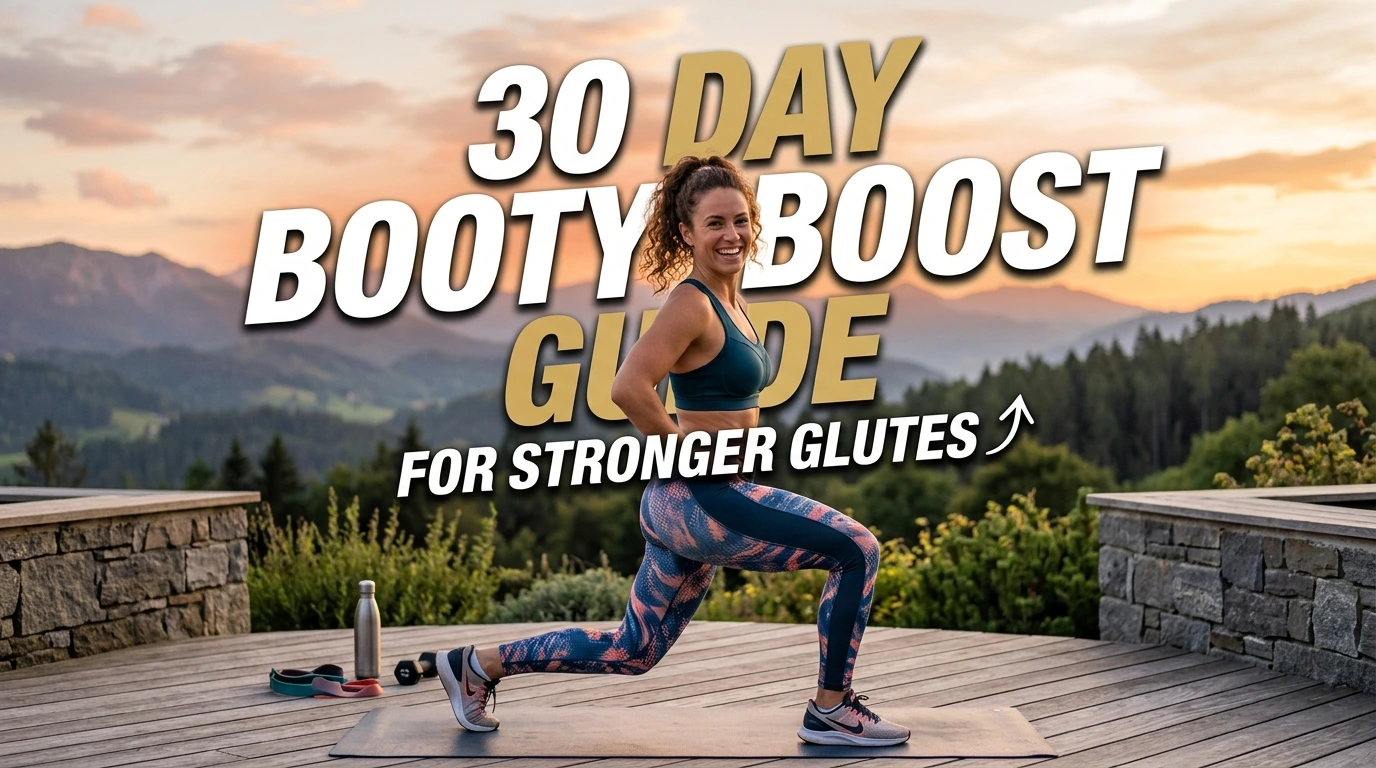
If you want a rounder, firmer, more lifted look without adding size to your legs, you are not alone. It is one of the most common fitness goals out there, and also one of the most confusing. Plenty of people squat and lunge for weeks, then notice their thighs growing while their glutes barely change.
This guide is here to help. We will walk through how a 30 day glute plan like the 30 Day Booty Boost is structured, why each part matters, and how you can set yourself up to follow it with confidence. Think of it as a friendly walkthrough from one person to another.
What Is the 30 Day Booty Boost?
The 30 Day Booty Boost is a month-long training plan built around one main goal: stronger, better-shaped glutes. You train six days a week, and each workout runs about 30 to 50 minutes.
It uses what its creators call the Glute Activation Method. Each session targets all three glute muscles through three kinds of work: activation, compound lifts, and isolation exercises. Total-body strength, core training, cardio, and active recovery are mixed in so you build a leaner, more athletic body overall.
The program comes from BODi, the wellness brand formerly known as Beachbody, and was launched in June 2026 with Super Trainer Chace Collett leading it. According to the official BODi press release, you will need a bench, dumbbells, Power Loops, and Strength Slides. If you like to compare memberships and current offers first, see our Trendytime BODi brand page.
Let’s break the plan down into six simple principles, so you understand not just what to do, but why.
Step 1: Get to Know Your Three Glute Muscles
Before training them, it helps to know what you are training. Your glutes are made up of three muscles:
- Gluteus maximus: the largest muscle, responsible for most of that rounded shape.
- Gluteus medius: sits on the upper outer part of the hip and adds width, plus stability when you walk, run, or stand on one leg.
- Gluteus minimus: the smallest, found beneath the medius, and it helps control the hip.
Many routines focus mostly on the maximus, usually through squats. That leaves the other two muscles undertrained. A balanced plan works all three so the shape looks even and your hips feel stable.
Your takeaway: when you choose exercises, ask yourself whether you are hitting all three muscles across the week, not just the biggest one.
Step 2: Start Every Session With Activation
Have you ever done a set of squats and felt it only in your thighs? That usually means your glutes did not switch on properly. Activation exercises fix this.
Activation work is light, controlled movement done at the start of a workout, such as glute bridges or banded side steps. The point is not to tire yourself out. The point is to wake up the glutes so they join in once you start lifting heavier.
Here is how to make activation count:
- Keep the weight light or use a resistance band.
- Move slowly and squeeze at the top of each rep.
- Place your hand on your glute and make sure you can feel it working.
- Spend five to ten minutes, no more.
Your takeaway: a short, focused warm-up can make every lift that follows more glute-friendly.
Step 3: Use Hip-Dominant Exercises to Keep the Focus Off Your Legs
This is the secret behind building glutes without bulking your legs. Some exercises are quad-dominant, meaning your thighs do most of the work. Others are hip-dominant, meaning your hips drive the movement.
Hip-dominant exercises usually have you pushing your hips back or driving them forward. Common examples include:
- Hip thrusts and glute bridges
- Romanian deadlifts and other hinge patterns
- Cable or band pull-throughs
- Step-ups with a forward lean and a strong hip drive
You do not have to avoid squats and lunges forever. You simply give hip-dominant work a bigger share of your week.
A friendly reminder: bodies are different. Genetics, training history, and nutrition all affect where you build muscle. Hip-dominant training shifts the emphasis toward your glutes, but it cannot promise one exact shape. Focus on getting stronger and enjoy the process.
Your takeaway: choose exercises where you can clearly feel your hips doing the work.
Step 4: Combine Compound Lifts and Isolation Work
A strong glute plan uses two types of exercises, and each has a job.
Compound lifts use several muscles and joints at once. They let you lift heavier and build overall strength. Think deadlift variations, hip thrusts, and split squats.
Isolation exercises focus on one muscle. They help you target the glutes directly and add volume once your bigger lifts are done. Think cable kickbacks, banded abductions, or single-leg bridges.
A simple way to order your session:
- Activation drills to switch the glutes on
- One or two compound lifts while you are fresh
- Two or three isolation exercises to finish the job
- Core or conditioning work, depending on the day
This order lets you lift your heaviest when your energy is highest, then fine-tune with targeted work at the end.
Your takeaway: big lifts build the foundation, and isolation work sculpts the details.
Step 5: Train the Whole Body, Including Your Core
It might sound odd, but a glute program works better when it does not ignore everything else. Total-body strength training helps you build a leaner, more athletic shape, and it keeps your physique balanced.
Your core deserves special attention. A strong core keeps your spine steady during heavy lifts, protects your lower back, and helps you keep your hips and ribs in the right position. If your lower back tends to take over during glute exercises, core strength can help.
Conditioning is the other piece. Short bursts of cardio raise your heart rate, improve your stamina, and make your workouts feel more intense without piling on endless heavy sets.
Here is a sample way to think about your week:
- Glute-focused days: activation, compound lifts, and isolation work
- Upper body or total-body days: keep your whole frame strong
- Core and cardio days: build stability and endurance
- Active recovery day: light movement to reset
Your exact schedule will depend on the plan you follow, but this gives you a clear picture of how the pieces fit together.
Your takeaway: a stronger core and better conditioning make your glute training safer and more effective.
Step 6: Treat Recovery as Part of the Plan
Muscle does not grow during the workout. It grows while you rest. Training six days a week only works if recovery is built in, which is why active recovery matters.
Active recovery means gentle movement instead of complete rest. It can include mobility drills, light stretching, or an easy walk. These sessions support:
- Mobility: moving freely through your joints
- Flexibility: keeping muscles from feeling tight
- Better movement: making your next workout feel smoother
Good recovery also includes habits outside the gym:
- Sleep consistently, since this is when your body does most of its repair work.
- Eat enough protein and overall calories to support muscle growth.
- Drink water throughout the day.
- Take extra rest if you feel pain, not just normal soreness.
Your takeaway: consistent recovery lets you keep progressing instead of burning out by week two.
How to Plan Your 30 Days
Knowing the steps is one thing. Putting them into your real life is another. Here is a simple way to approach the month.
Week 1: Learn the movements. Use lighter weights and focus on form and feeling your glutes work. This is the time to build good habits.
Week 2: Build momentum. Once the movements feel familiar, add a little weight or a few extra reps where you can.
Week 3: Push a bit harder. Your body has adapted, so this is a good time to challenge yourself while still keeping clean technique.
Week 4: Finish strong. Aim to beat your earlier numbers, then take stock of how far you have come.
Before you begin, take a few simple measurements. You might snap a starting photo, note the weights you use, and write down how you feel. Looking back at these after 30 days gives you something real to compare.
Common Mistakes to Avoid
Even with a great plan, a few habits can slow you down.
- Rushing your reps. Slow, controlled movement builds more muscle than swinging through a set.
- Skipping the warm-up. Activation is the part that helps your glutes show up.
- Lifting too heavy too soon. Poor form shifts the work to your lower back or quads.
- Ignoring rest. More is not always better, especially when you train six days a week.
- Expecting overnight change. Visible results build over time, so patience helps.
Who Should Think Twice Before Starting?
This type of plan suits people who want structure and are ready for regular training. If you are brand new to exercise, you may want to start with fewer days a week and build up gradually. If you have an injury, a health condition, or any concerns, speak with a doctor or a qualified trainer first. A plan only works when your body can handle it safely.
Frequently Asked Questions
How long are the workouts?
Each session lasts roughly 30 to 50 minutes, which makes it easier to fit into a busy schedule.
How many days a week should I train?
The plan runs six days a week, with active recovery included to support mobility and flexibility.
Will this make my legs bigger?
Hip-dominant training keeps the focus on your glutes, but individual results vary based on genetics, nutrition, and your training history.
Do I need a gym?
The official program uses a bench, dumbbells, Power Loops, and Strength Slides, so a full gym is not required. If you do not have all of that, a simple home setup with dumbbells and bands can work for similar movements.
Can beginners follow this?
Yes, with adjustments. Start with lighter weights and fewer days if needed, and focus on learning proper form first.
Final Thoughts
Building stronger glutes is not about doing one magic exercise. It comes from training all three muscles, switching them on with activation work, leaning on hip-dominant movements, mixing compound and isolation exercises, strengthening your core, and recovering well. That is the thinking behind the 30 Day Booty Boost, and it is a useful framework even if you adapt it to your own routine.
Take it one workout at a time, stay patient, and give yourself credit for showing up. Thirty days of steady effort can teach you a lot about what your body can do.
Want to save on workout gear, bands, or fitness programs? Check the latest deals on Trendytime BODi brand page.